The wrinkle reducer, Botox is approved by the FDA for very narrow uses only. But Allergan, its manufacturer, has promoted it to doctors all over the country for other uses, including muscle spasms. A doctor’s use of a drug for a purpose not approved by the FDA is often referred to as an “off-label” use. When a doctor used Botox “off-label” to treat Virginian Douglas Ray for hand tremors, it quickly led to brain damage. According to his wife, he now requires round-the-clock care and speaks very few words.

Botox is a purified form of the poison botulinum and is given as an injection. The drug is approved to treat “muscle stiffness” in the fingers and arms, “upper limb” spasticity, and chronic migraine headaches. Botox can migrate outside the injected muscles and cause side effects including botulism and severe autoimmune reactions with resulting brain damage.

Ray claimed Allergan did not properly warn his doctor about the risks of using the drug. A jury agreed, ordering Allergan Inc. to pay to Ray $12 million in compensatory damages and $200 million in punitive damages. This award by the U.S. District Court jury in Richmond, Va., was the largest penalty ever in a Botox injury case.

Botox is Allergan’s top-selling drug, with $1.42 billion in sales last year, or 29 percent of the drug maker’s revenue, according to data collected by Bloomberg.

This is not the first time the Botox manufacturer has had to pay penalties. In September of 2010, the federal government ordered Allergan to pay $600 million to settle civil and criminal allegations against the drug manufacturer for illegally marketing Botox for other uses. Allergan has also been accused of paying kickbacks to doctors and enticing them with all expense paid weekends to learn about off-label usage. 

In July 2009 — more than a year before the San Bruno explosion — we warned about the dangers to the public posed by PG&E’s aging underground infrastructure.  Back then, we were focusing on the utility vaults hidden beneath the streets and sidewalks of San Francisco and other urban areas.  They have a long history of exploding without warning. We called them "timebombs beneath the streets" because, frankly, that’s what they are.


When the newscast aired, PG&E pledged it was doing all it could to fix the problem of its aging infrastructure.  We didn’t believe them. 

And then the San Bruno fire happened.

Now, almost two years after the newscast first aired, Steve Johnson of the San Jose Mercury News has begun to investigate the hazards posed by PG&E’s underground vaults.  Perhaps the most astounding part of his front page article  is that PG&E appears to have no idea of exactly how many of its underground vaults have exploded over the past few years.

While this newspaper counted 78 Bay Area underground mishaps since 2005 PG&E said before Wednesday’s incident that it knew of just 35 throughout its entire service territory, which covers 70,000 square miles from Eureka to Bakersfield. The California Public Utilities Commission — which only tracks the worst accidents — said it is aware of 11 PG&E incidents during that period, six for Southern California Edison and none for San Diego Gas & Electric.

That doesn’t exactly instill us with confidence that PG&E — or the CPUC for the matter — is on top of the situation.  Who, then, is protecting public safety?

Usually, a homeowner who hires an independent contractor can delegate the responsibility for safety to the contractor. The theory behind the rule is that when an owner hires an independent contractor—or when a prime contractor hires a subcontractor—the responsibility for the safety of the contractor’s employees belongs with the independent contractor, not with the person who hired the contractor.

There is an important exception to the independent contractor rule. The rule does not apply to contractors who are not properly licensed. A provision of the California Labor Code  presumes that, for work that requires a contractor’s license, the unlicensed contractor is deemed to be an employee of the one who hires him and not an independent contractor. That can mean that the homeowner who hired the worker loses the protection of the independent contractor rule and can be held responsible for his worker’s safety, just as any other employer.

Recently the California Supreme Court held that a significant residential remodel, even one managed by an owner-builder and not by a professional contractor, was subject to the Cal-OSHA regulations. As discussed here, significant remodel is exactly the type of construction activity that OSHA was intended to regulate, and was not a “household domestic service” like tree trimming or home maintenance that was exempt from regulation.  The Court’s ruling allows the unlicensed injured worker to proceed with his lawsuit against the homeowner, and to introduce into evidence the violations of Cal-OSHA regulations to establish the homeowner’s fault.

Decompressive craniectomies are an aggressive surgical strategy increasingly used at trauma centers for victims of diffuse traumatic brain injury. Although surgical methods vary, the decompressive craniectomy involves temporarily removing a portion of the skull to relieve the pressure from the swelling of the injured brain.

As recently reported in the New England Journal of Medicine, results of a randomized trial show that although decompressive craniectomy reduced intracranial pressure and the length of stay in the intensive care unit, it was also associated with a greater risk for unfavorable outcome at 6 months for patients with diffuse traumatic brain injury (TBI) compared with standard care. The standard care involves lowering the patient’s body temperature and administering barbiturates.Rates of death didn’t differ between groups, but scores on the Extended Glasgow Outcomes Scale were lower in the group undergoing bifrontotemporoparietal craniectomy, and there was a significant increase in risk, more than double, for an unfavorable outcome on that same scale, the researchers report. The unfavorable outcomes included vegetative state and conscious but disabled.

Our findings differ from those of most nonrandomized studies and are contrary to our hypothesis," the researchers, with lead study author D. James Cooper, MD, from the Department of Intensive Care at Alfred Hospital, Monash University, in Melbourne, Australia, acknowledge. " Our unexpected findings underscore the critical importance of performing such trials to test common therapies, particularly in patients with complex critical illnesses."

Experts stress that that the procedure should not be abandoned on the basis of these results. Surgeons must think more carefully about the risks and benefits of the decompressive craniectomy before performing the procedure and must work to further define appropriate clinical settings for this procedure.


Without a judge to preside over their claims, the San Bruno fire victims’ lawsuits have, up until now, been in limbo. That will soon change, as Judge Steven Dylina has just been assigned to hear all the suits arising from the PG&E fire, wherever those suits may have been filed. The first hearing in the cases should be scheduled within the next two weeks. The order assigning Judge Dylina is here.

Meanwhile, the California Public Utilities Commision continues to investigate PG&E’s management and maintenance practices. But PG&E is already crying foul. According to Steve Johnson’s latest article in the San Jose Mercury News, PG&E objects to the CPUC’s "tone":

In a testy response to the commission’s order that by Monday it answer questions about its record-keeping practices, PG&E’s attorneys said the agency seems to be starting "with a presumption of guilt" that is "contrary to American precepts of due process."

It’s a bit ironic to hear PG&E complain that it has not been afforded "due process," given that its victims have been waiting for months for their chance to be heard at all. 

Homeowners who hire workers must comply with Cal-OSHA safety regulations. Those regulations require the homeowner, as an employer, to furnish a “safe and healthful” place of employment. “Employment” means "the carrying on of any trade, enterprise, project, industry, business, occupation, or work, including all excavation, demolition, and construction work, or any process or operation in any way related thereto, in which any person is engaged or permitted to work for hire, except household domestic service."

The question, then, is what type of work qualifies as “construction” (so that Cal-OSHA applies), and what type is “household domestic service” (so that it doesn’t)?

The courts say that “household domestic service” means household maintenance both inside and outside the residence. If a homeowner hires a worker to clean house, garden or trim trees, Cal-OSHA doesn’t apply under the “household domestic services” exception. But the homeowner must comply with Cal-OSHA when hiring workers for extensive remodeling. The Court recently determined that Cal-OSHA applies to a remodeling project calling for the demolition and rebuilding of significant portions of a house and the construction of new rooms. And, the homeowner may be liable for injuries to a worker caused by failure to comply with Cal-OSHA.

Because Cal-OSHA will apply to an extensive remodeling project, the homeowner who handles his own project must be sure to implement and administer his own Cal-OSHA compliance programs, or to hire licensed independent contractors to do that for them, and to place safety compliance obligations squarely with their contractors through appropriate language in the construction agreements.
 

Following a recent threat by Air Canada to pull its sponsorship dollars, the NHL announced a revision of the NHL Protocol for Concussion Evaluation and Management. The Protocol now requires:

  1.  Mandatory removal from play if a player reports any listed symptoms or shows any listed signs of a concussion;
  2. Examination by the team physician in a quiet place free from distraction and use of "an acute evaluation tool" by team physicians rather than a quick rinkside assessment.
  3. The NHL board will be asked to elevate the standard for holding a team and its coach accountable if there are a number of "repeat offenders" with regard to supplementary discipline.
  4. A safety engineering firm will evaluate all 30 arenas and determine what changes, if any, can and should be made to enhance player safety.
  5.  A ‘blue-ribbon’ committee of former players including Brendan Shanahan, Rob Blake, Steve Yzerman and Joe Nieuwendyk will look at safety issues.

The Ontario Hockey League has been a proponent of concussion education. Its president David Branch gives a nod to the NHL revisions but emphasizes that it does not go as far as the OHL which penalizes all hits to the head.  Also, the OHL has circulated a DVD to its players. OHL said:

The message to players is: You have to recognize these symptoms and you have an obligation to tell your team . . . We’ve got a problem with head injuries in our game and you are part – part – of the solution. It wasn’t intended to scare them. It wasn’t a threat – that we plan to suspend you. It was intended to educate, to get buy-in from the players, and to support the players.”

Thumbs up to Air Canada and the professional hockey leagues.  As they encourage education about brain injuries education, their fans will also better understand the seriousness of concussions.

Where will the San Bruno fire cases be heard? This morning, Judge Forcum ruled that all of the cases should be heard by one judge, and that judge should be in San Mateo County. That was no surprise. Now, it’s up to the Chief Justice of the California Supreme Court to approve Judge Forcum’s ruling. When she does that (and there’s little question that she will), a judge will be selected from the San Mateo bench to handle all the cases. We’re expecting a judge to be picked within the next three weeks.  Until then, the PG&E cases remain at a standstill.

One of the lawsuits that Judge Forcum ordered coordinated with all the others was a lawsuit brought by PG&E shareholders against PG&E management. The shareholders claim that management knew about the problems with the pipeline and did nothing to stop the explosion from happening. By allowing the explosion, the lawsuit claims, management hurt the price of PG&E’s stock.

The only argument at today’s hearing centered around that case. PG&E argued that that the shareholder lawsuit should not be coordinated with the others because the questions in that case have little to do with those in the personal injury suits. Therefore, PG&E argued, they should not be all lumped together. Judge Forcum disagreed. The shareholder suit is all about what PG&E management knew about the dangers and when they knew it. But that question is also important in the personal injury lawsuits because it may determine whether PG&E should be liable to the San Bruno residents for punitive damages.


Does the recent NASA report spell trouble for the plaintiffs’ attorneys in the Toyota Unintended Acceleration Litigation?

No. Electronic malfunction was not the sole theory relied upon by victims of unintended acceleration. The strategy in most product defect litigation is (1) identify an aspect of the products design that caused the injury; and (2) show that there was a reasonably feasible alternative design that would have prevented the injury. If the victims can prove those two things, then the product was defective.

Here, Toyota has identified at least two known aspects of the vehicle’s design that can cause SUA: (1) floor mat interference with the throttle pedal; and (2) “sticky” throttle pedals. Safety advocates, industry experts, and (yes) plaintiffs in Toyota suits have identified a third: electronic malfunction.

All three of the possible design issues could have been prevented by Toyota installing a brake override system. Regardless of which design problem is ultimately proven responsible for SUA, the brake override system solves the problem.

Toyota could have implemented a brake override system for less than $1 per vehicle, but it didn’t. 

Your tire is losing air. You drive to the gas station and learn you’ve "picked up a nail." The guy says he can fix the tire in 10 minutes with a "plug." He doesn’t even have to take the tire off the rim. Ten bucks. Wow. Sounds pretty good. And what’s the worse thing that can happen if it doesn’t work? It’ll leak again, right?

Actually, an improper patch or plug repair can cause the tire tread to peel off the tire. That, in turn, can cause the vehicle to become uncontrollable, leading to the most dangerous type of accident there is — a rollover. And it happens more often than you’d think.

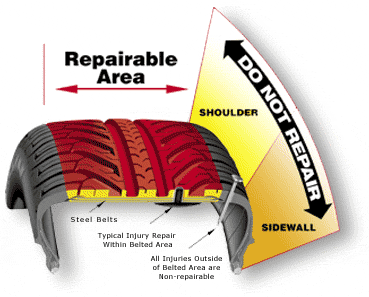
The weak part of the tire is where the steel belts bond with the tire’s shoulder. An improper "on the Repairable Area of Tirewheel" repair can allow moisture to get to the steel belts and weaken the bond. That’s what causes the detread. The three things to remember are:

1. No on-the-rim repairs. The tire must be dismounted so that the tire can be properly inspected and sealed against moisture. If the guy at the garage says he can fix the tire without taking it off the rim, he isn’t doing you a favor. He is putting you and your family at risk.

2. No repairs near the shoulder. The shoulder of the tire is the weakest part.  So only those holes in the middle of the tire can be repaired.  If you pick up a nail near the shoulder, you need a new tire.

3. If you decide to get a new tire, the new tread must go on the rear axle. Installing the new tread on the front axle can lead to a loss of control and rollover for reasons unrelated to tread separation.

Gas station mechanics are supposed to know better. That’s their job. But many don’t.